
Community Medicine is a successor of what was previously known as Social and Preventive Medicine. It is the speciality which deals with population and comprises those doctors who try to measure the needs of the population, both sick and well, who plan and administer services to meet those needs, and those who are engaged in research and teaching in the field.
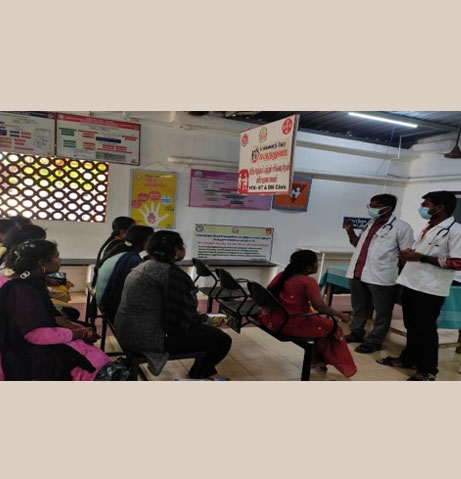
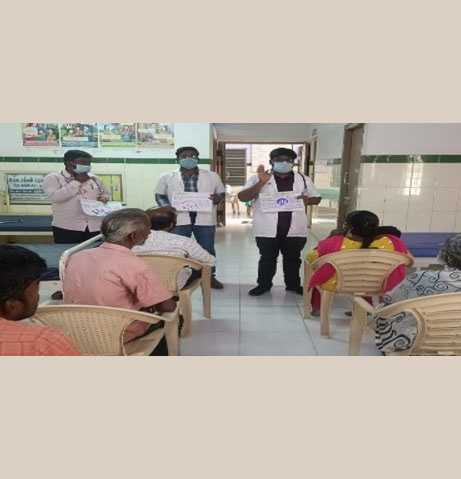
The academic capacity and activities of the Department of Community Medicine at Government Medical College Tiruppur have gradually increased. The department actively participates in community health programmes, such as screening for non-communicable illnesses and health education in both rural and urban regions, in addition to offering undergraduate education. In collaboration with rural health training centre, specialised clinics and mobile health camps are also offered in rural areas where healthcare is inaccessible. The department aids in the implementation of National Programmes.
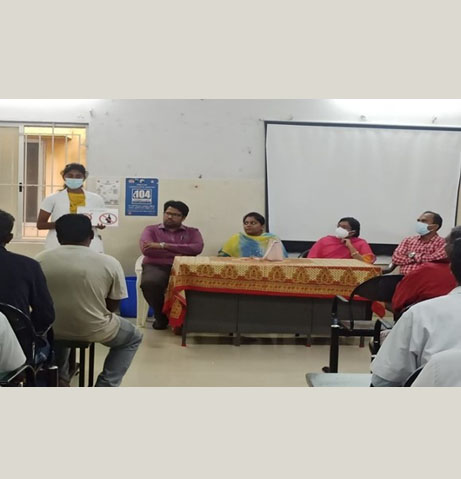
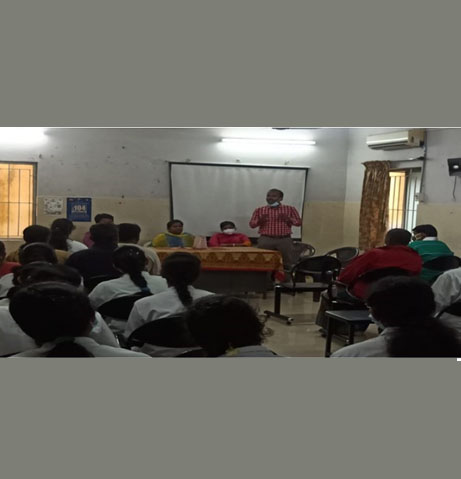
The Department observes important health days and events. Numerous community-based initiatives are organised, and interns and students take an active part in them. The medical undergraduate (MBBS) students receive public health training through interactive lecture classes, field trips, and visits to rural and urban health centres where they actively participate in family adoption programme, family surveys, field trips and special visits to PHCs, sub-centres, and ICDS centres. The department occasionally also holds workshops on the fundamentals of research methods.
Undergraduate teaching as per CBME curriculum is incorporated for all student. Lectures, small group discussions, self-directed learning, seminars, roleplay are conducted to undergraduates. Postings in Health training centres help them to get an idea of primary health care which is the first level of contact between the general public and health care system. They are trained on principles of health education and communication which helps them to become an Indian Medical Graduate.
Family adoption programme is implemented for all the students as per NMC guidelines. One student is allotted five families which has to be followed up for three years. The changes in demography and health status/ events will be monitored and the report will be generated at the end of three years. This will help them understand the concept of family physician and importance of primary health care. It also ensures a healthy bond between the community and the medical students.
The Department of Community Medicine strives to achieve the competencies for Indian Medical Graduate as per NMC norms.
CRMIs are posted in rural and urban health centres, where they receive training in the principles of public health and discover the numerous elements influencing health status. They participate in a variety of outreach initiatives, including family surveys, special clinics, and health education initiatives. At the end of postings, all CRMIs will be capable of administrating a Primary health centre.
Under District Residency Programme, MD Community Medicine Postgraduates are posted for 3 months in the Department of Community Medicine. They are trained on National Health Programmes, health planning and management, basic biostatistics and epidemiology, special clinics. Regular pedagogy sessions and journal clubs are being conducted in the department.
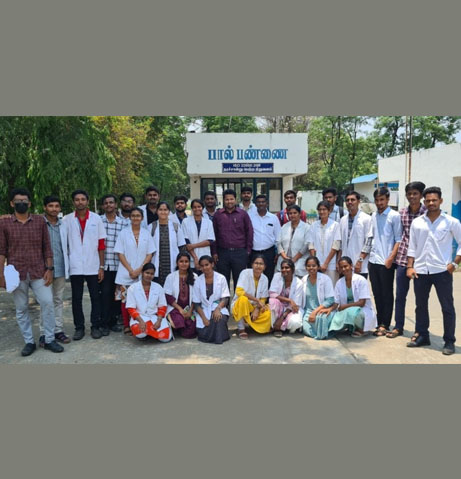
* Rural health training
centre- Government Perumanallur
PHC
* Urban health training centre- TSK Urban PHC
* Undergraduate teaching
* CRMI training
* DRP training
* Family adoption programme
* Visit to CHC/PHC/HSC
* Health education to general public
* Field visits
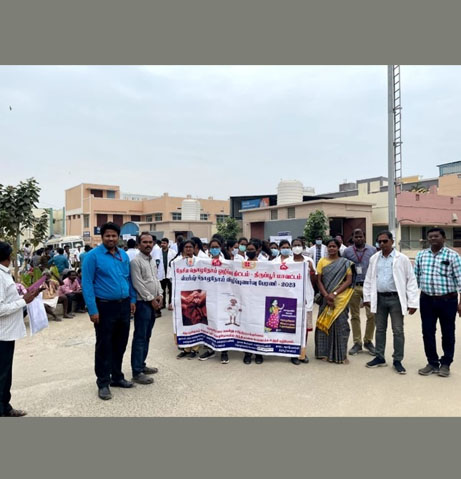
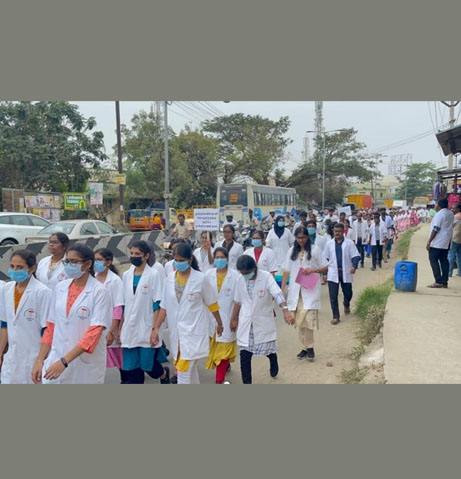
* Rally- National Leprosy Day 30.01.2023 awareness
activities
A rally was conducted to generate awareness for Leprosy on behalf of the Department of Community Medicine on 30.01.2023 at 12 pm. MBBS students, nursing students and CRMIs of Government Medical College Tiruppur participated in the rally.
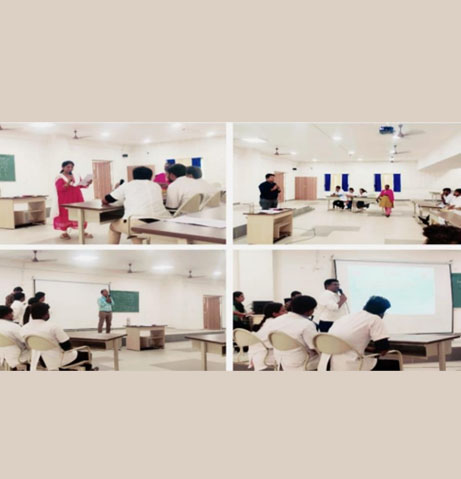
IAPSM- WHD- QUIZ- 2024
In view of World Health Day, which is celebrated every year
on
April 7, Department of Community Medicine, Government
Medical
College Tiruppur, participated in the nationwide
IAPSM-WHD-QUIZ-2024 with the
aim to sensitize MBBS students
on the theme “My Health, My Right.”
Winners:
First place- SHREENITHI A M (III MBBS), KAUYA M (III MBBS),
KARANKUMAR. T (III MBBS)
Second place- SHOAIB AHMED N (III MBBS), SHARATH SRINIVASAN
R
(III MBBS), AVENTHIKA S (III MBBS)
Third place- UDHAYA CUMAAR (III MBBS), KIRTHICK S (III
MBBS),
DHANYA (III MBBS)
The academic capacity and activities of the Department of Community Medicine at Government Medical College Tiruppur have gradually increased. The department actively participates in community health programmes, such as screening for non-communicable illnesses and health education in both rural and urban regions, in addition to offering undergraduate education. In collaboration with rural health training centre, specialised clinics and mobile health camps are also offered in rural areas where healthcare is inaccessible. The department aids in the implementation of National Programmes.
The Department observes important health days and events. Numerous community-based initiatives are organised, and interns and students take an active part in them. The medical undergraduate (MBBS) students receive public health training through interactive lecture classes, field trips, and visits to rural and urban health centres where they actively participate in family adoption programme, family surveys, field trips and special visits to PHCs, sub-centres, and ICDS centres. The department occasionally also holds workshops on the fundamentals of research methods.
Undergraduate teaching as per CBME curriculum is incorporated for all student. Lectures, small group discussions, self-directed learning, seminars, roleplay are conducted to undergraduates. Postings in Health training centres help them to get an idea of primary health care which is the first level of contact between the general public and health care system. They are trained on principles of health education and communication which helps them to become an Indian Medical Graduate.
Family adoption programme is implemented for all the students as per NMC guidelines. One student is allotted five families which has to be followed up for three years. The changes in demography and health status/ events will be monitored and the report will be generated at the end of three years. This will help them understand the concept of family physician and importance of primary health care. It also ensures a healthy bond between the community and the medical students.
The Department of Community Medicine strives to achieve the competencies for Indian Medical Graduate as per NMC norms.
CRMIs are posted in rural and urban health centres, where they receive training in the principles of public health and discover the numerous elements influencing health status. They participate in a variety of outreach initiatives, including family surveys, special clinics, and health education initiatives. At the end of postings, all CRMIs will be capable of administrating a Primary health centre.
Under District Residency Programme, MD Community Medicine Postgraduates are posted for 3 months in the Department of Community Medicine. They are trained on National Health Programmes, health planning and management, basic biostatistics and epidemiology, special clinics. Regular pedagogy sessions and journal clubs are being conducted in the department.
* Rural health training
centre- Government Perumanallur
PHC
* Urban health training centre- TSK Urban PHC
* Undergraduate teaching
* CRMI training
* DRP training
* Family adoption programme
* Visit to CHC/PHC/HSC
* Health education to general public
* Field visits
* Rally- National Leprosy Day 30.01.2023 awareness
activities
A rally was conducted to generate awareness for Leprosy on behalf of the Department of Community Medicine on 30.01.2023 at 12 pm. MBBS students, nursing students and CRMIs of Government Medical College Tiruppur participated in the rally.
IAPSM- WHD- QUIZ- 2024
In view of World Health Day, which is celebrated every year
on
April 7, Department of Community Medicine, Government
Medical
College Tiruppur, participated in the nationwide
IAPSM-WHD-QUIZ-2024 with the aim to sensitize MBBS students
on
the theme “My Health, My Right.”
Winners:
First place- SHREENITHI A M (III MBBS), KAUYA M (III MBBS),
KARANKUMAR. T (III MBBS)
Second place- SHOAIB AHMED N (III MBBS), SHARATH SRINIVASAN
R
(III MBBS), AVENTHIKA S (III MBBS)
Third place- UDHAYA CUMAAR (III MBBS), KIRTHICK S (III
MBBS),
DHANYA (III MBBS)
IAPSM-WHD-QUIZ-2023
In view of World Health Day, which is celebrated every year
on
April 7, Department of Community Medicine, Government
Medical
College Tiruppur, participated in the nationwide
IAPSM-WHD-QUIZ-2023 with the aim to sensitize MBBS students
on
the theme “Health for All”
First prize- Shoaib Ahmed N, Sharath Srinivasan R, Sanjay M
The Department of Community Medicine, Government Medical College Tiruppur strive to inculcate communication skills, managerial and leadership qualities required for CRMIs, so as to lead and perceive themselves as a Resolute Health professional. 7 CRMIs presented in PREVENCON 2023, National conference.
NATCON- 2024- International
Conference
Best poster presentation- Tamil Amuthan, II year MBBS
PREVENCON 2023- National Conference
Best oral presentation- V. Prasannakumar, CRMI
Best poster presentation- S. Ragul Raja, CRMI
In view of World Health Day 2024, Department of Community Medicine conducted events for MBBS students for creating awareness on the theme My Health, My Right. Photography, Short film, face painting and speech were the competitions conducted.
1 AJAY – I MBBS
2 RAJESH – CRMI
3 GAYATHRI – CRMI
1 CRMI team
2 III MBBS team
3 I MBBS team
DIVYA DARSHINI – III MBBS
MARY SUJITHA – CRMI
PRAVIN VASANTH – 1 MBBS
KAMALEE N J – III MBBS
SHREENITHI A M – III MBBS
INDUPRIYA – III MBBS
The
Department of Community Medicine at Government Medical
College Hospital (GMCH),
Tiruppur, is equipped with well-established
infrastructure that supports
undergraduate and postgraduate training, research
activities, and
community-based service delivery. The department is
designed to facilitate
academic excellence, field-based learning, and public
health research in
alignment with National Medical Commission (NMC)
guidelines.
Academic
Facilities
The
department houses spacious faculty rooms, tutorial
rooms, and seminar halls
equipped with audio-visual teaching aids to ensure
effective learning. A
dedicated demonstration room is available for practical
sessions, small group
discussions, and skill-based training. The department
actively promotes
interactive teaching methodologies including DOAP
sessions, problem-based
learning, and community-oriented training
modules.
A
well-maintained departmental library with updated
textbooks, reference
materials, national health programme guidelines, and
access to online journals
supports academic enrichment for both students and
faculty.
Research
and Data Facilities
The
department is equipped with computer systems, high-speed
internet connectivity,
printers, and statistical software to support research
activities. Facilities
are available for data entry, analysis, and report
preparation. The department
encourages undergraduate ICMR projects, postgraduate
dissertations, faculty
research, and collaborative public health
studies.
Urban
and Rural Health Training Centres
The
department manages designated Urban Health Training
Centre (UHTC) and Rural
Health Training Centre (RHTC) which serve as field
practice areas for
undergraduate and postgraduate training. These centres
provide hands-on
exposure to:
These
field practice areas ensure students gain real-time
experience in public health
planning, implementation, and evaluation.
Museum
and Skill Laboratory
The
department maintains a Community Medicine museum
displaying models, charts,
demographic tools, nutritional assessment instruments,
environmental health
models, and national health programme materials to
enhance visual learning.
Basic
public health skill training equipment including
anthropometric tools,
hemoglobin estimation kits, glucometers,
sphygmomanometers, and field survey
tools are available for practical demonstrations.
Transportation
and Field Support
Vehicles
are available for field visits, community surveys,
outbreak investigations, and
health camps, enabling effective community engagement
and experiential
learning.
The
Department of Community Medicine at Government Medical
College Hospital,
Tiruppur, plays a pivotal role in integrating
preventive, promotive, curative,
and rehabilitative aspects of health care through
academic training, community
engagement, and public health services. The department
functions as a bridge
between the hospital and the community, ensuring
comprehensive health service
delivery.
Preventive
and Promotive Health Services
The
department actively participates in the implementation
and monitoring of
various National Health Programmes. Regular health
education activities are
conducted for the community focusing on:
Health
awareness camps, screening camps, and outreach programs
are regularly organized
in urban and rural field practice areas.
Primary
Health Care Delivery
Through
the Urban Health Training Centre (UHTC) and Rural Health
Training Centre
(RHTC), the department provides comprehensive primary
health care services
including:
These
services ensure community-based learning for students
while simultaneously
improving health access for the population.
Disease
Surveillance and Outbreak Response
The
department contributes to disease surveillance
activities, data analysis, and
reporting. Faculty members and postgraduate students are
involved in:
This
strengthens public health preparedness and response
mechanisms in the region.
Screening
and Early Detection Services
The
department conducts screening programs for:
Early
identification and referral contribute to better health
outcomes in the
community.
Academic
and Research Services
The
department provides academic mentorship for
undergraduate students and faculty
in:
Faculty
members undertake research projects addressing local
public health priorities
and contribute to evidence-based policy and
practice.
Community-Based
Training and Capacity Building
The
department conducts training programs for:
Capacity-building
initiatives aim to strengthen health systems and improve
service delivery at
the grassroots level.
The
Department of Community Medicine at Government Medical
College Hospital,
Tiruppur, conducts comprehensive undergraduate and
postgraduate academic
activities in accordance with the National Medical
Commission (NMC) –
Competency Based Medical Education (CBME) curriculum and
Postgraduate Medical
Education Regulations.
The
department is committed to producing socially
accountable, ethically grounded,
and research-oriented medical graduates equipped to
address public health
challenges.
Undergraduate
Training (MBBS)
Under
the NMC Competency Based Medical Education framework,
the department conducts
structured teaching programs across Phase I, Phase II,
and Phase III Part I of
MBBS training.
Phase
I (Foundation & Early Exposure)
Phase
II
Phase
III Part I
Teaching
methodologies include:
Formative
assessments, internal assessments, logbooks, and
competency tracking are
maintained as per NMC norms.
Internship
(CRMI) Training
Compulsory
Rotatory Medical Internship (CRMI) postings
include:
Interns
are trained in community diagnosis, outbreak
investigation basics, and public
health reporting.
Electives
and Research Training
The
department facilitates:
Students
are encouraged to participate in conferences, paper
presentations, and
publications.
Continuing
Medical Education (CME) and Faculty
Development
The
department regularly organizes:
These
academic activities strengthen knowledge dissemination
and professional
development.
Undergraduate
Medal Examination
The
Department of Community Medicine conducts the
Undergraduate Medal to encourage
academic excellence among MBBS students.
The
examination is open to MBBS students of Phase III part I
of Government Medical
College Tiruppur. It typically includes a structured
prelim, family study at
field, viva voce, and evaluation of problem-solving
abilities in epidemiology
and public health scenarios. The medal examination aims
to identify and reward
students with exceptional conceptual clarity, analytical
skills, and
application-oriented understanding of Community
Medicine. Successful candidate
is awarded gold medal and certificate, fostering a
culture of scholarly
achievement and healthy academic competition.
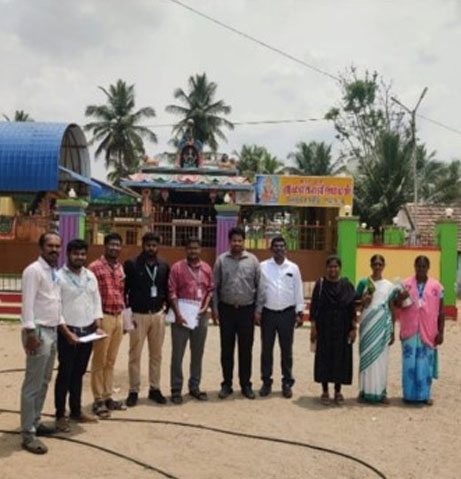
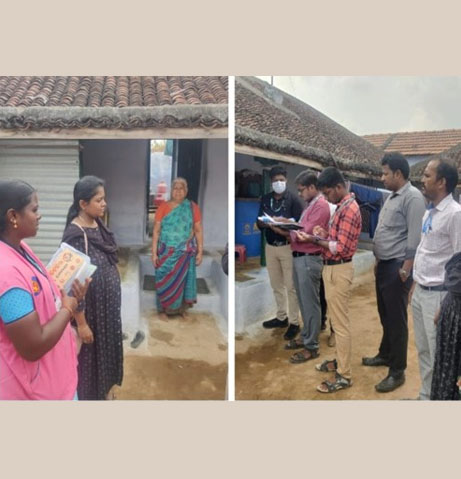
Faculty are actively involved in both hospital-based and community based (rural and urban) research projects. At the primary health centres and in the community level, community-based research is conducted in the form of field studies, occupational studies, and evaluation surveys. The main areas include: Non-communicable diseases, communicable diseases, vector-borne diseases, Maternal and Child health, immunisation, mental health, occupational health, geriatric health, evaluation of national health programmes, health planning and management.
Evaluation of NCD care cascade
under ‘Makkalai Thedi Maruthuvam’
in Tamilnadu – a cross-sectional study
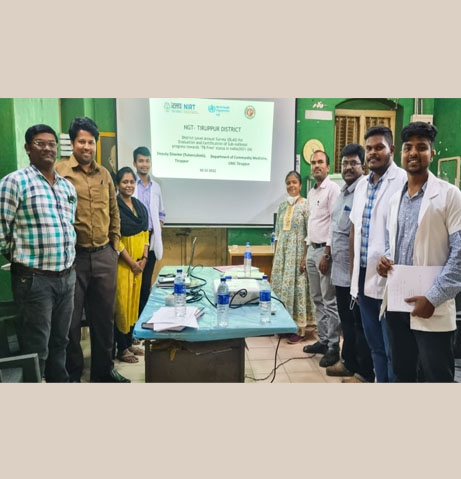
Verification of Claims for Sub-National Certification of
Progress Towards TB Free Status for the year 2022- Tiruppur
District
A cross sectional study to assess the awareness of rabies
among
dog bite victims attending primary health center, Tiruppur
Prevalence of obesity and hypertension among women over 35
years
of age attending the outpatient department in the community
health center, Perumanallur of Tiruppur district and their
knowledge, attitude, practice regarding obesity and
hypertension
Knowledge and prevalence regarding refractive error among
population attending the outpatient department in
ophthalmology
department, Tiruppur
Prevalence of osteoarthritis of knee and its associated risk
factors among late middle age population (45 – 60 years) at
Perumanallur, Pongalur & TSK primary health center,
Tiruppur.
Diabetes self-care activities among adult diabetic patients
attending medical OPDs of primary health care centers of
Tiruppur district
A study on PMS among undergraduate female students in a
Tertiary
care hospital, Tiruppur
A study on quality of life among geriatric population
attending
primary health center in Tiruppur district.
Awareness and usage of artificial intelligence among medical
college students in Tiruppur- a cross sectional study.
Knowledge, attitude and awareness towards cadaveric organ
donation among paramedical workers in Government Medical
College
and Hospital, Tiruppur.
Challenges faced by FMG’s after graduation and during
internship
Quality of life among tuberculosis patients attending PHCs
in
Tiruppur- a cross sectional study
Knowledge, attitude and practice about exclusive
breastfeeding
Knowledge attitude and practice on No Scalpel Vasectomy
(NSV)
among married men of age group above 21 years in rural part
of
Tiruppur- a cross sectional study.
Research
methodology workshop 2023
World
Health Day CME 2024
Rabies
CME 2025
CAMBRISP
Community Medicine Medal examination 2025